
The investment industry construct: where capital comes to die

In the summer of 2026, North Star Transition hosted a London meeting of investment industry professionals to explore the purpose of the investment industry. Led by Tim Hodgson, the meeting asked whether the investment system could continue as before as boundary after planetary boundary is breached. We invited Tim to share his analysis of the future facing this industry.
Of the many divisions that trouble our world, the one that matters most is the slow one. Geo-physical planetary systems are on one pathway; human socio-economic systems on another. They have diverged for decades, with — so far — little immediate cost. Seven of the nine planetary boundaries are now breached. The scientists are blunt; the economists and financiers, for the most part, apathetic.
That gap is not anyone's fault in particular. It emerges from a complex adaptive system that searches out energy ... grows ... throws off profit ... and poisons its own living space as a by-product. The system has no values, because emergence has no values. You cannot change it by exhortation or by tweaking incentives at the edges; you have to change the paradigm it runs on — which, as Donella Meadows argued, is the deepest place to intervene.
Five paradigms, then two basins
My original worldview set out five paradigms for the investment industry: Extract → Optimise → Sustain → Repair → Regenerate. Profitability falls left to right, and so does ecological damage. Extract is both the most profitable and the most destructive. The uncomfortable conclusion is that even Sustain has to die. Why sustain a system that has already breached seven of its boundaries?
Put to a room of senior investment people, that argument met a sharp correction: the neat left-to-right line does too much work. Extract, Optimise and Sustain are not three stops on a journey — they are one locked cycle, held by their own reinforcing feedback. In systems language, they form a basin of attraction, a low place in a landscape that pulls behaviour back. The five paradigms collapse into two basins — an overshoot basin (Extract, Optimise, Sustain), where every incentive and metric keeps us in the basin, and a regenerative basin (Repair, Regenerate), with a different gravity. Note that we can see the second basin and feel its pull, but nobody in the room could say how to reach it. The gap is not a step; it’s a discontinuity — and an industry whose genius is incremental optimisation has no tool for crossing discontinuities.
The five investment paradigms collapse into two basins - but how do we get to the regenerative basin?
One pit, two ways down
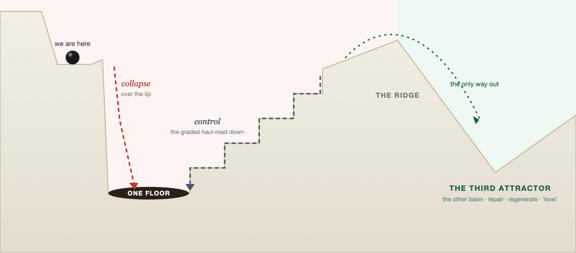
A piece of reading sharpened the map: Ernesto van Peborgh on the "third attractor" (a concept he credits to Daniel Schmachtenberger). It names three attractors, and the obvious move is to add a third basin. That move is wrong. The three are not three of a kind; they are two against one. The first is collapse - extraction run to exhaustion. The second is techno-authoritarian control - stabilising collapse from above, through central optimisation and surveillance. The third is alignment with life - reciprocity instead of extraction, participation instead of separation. The first two are siblings: both express the same dying paradigm, one failing through disorder, the other through rigid order. Only the third is another pathway entirely. (Three attractors are a simplification, not a census of the possible; the argument needs only that they are the strong ones the present landscape exerts.)
So the picture that fits is an open-pit mine. We circle fairly high on the rim. There are two ways down: straight over the lip (collapse), or round and down the graded haul-road, terrace by terrace (control). They feel utterly different — one catastrophe, the other careful engineering — but they reach the same floor, because control never stops being extraction; it only represses the symptoms. The only true exit is the climb up the far wall, over the ridge, into the other basin. Neither route down brings you nearer it.
Why the descent looks like progress
Why take the graded road down and call it progress? Because the paradigm is the water we swim in, and do not see. From inside, the orderly descent looks like responsibility — more data, more central management, more grip on the wheel — and these read as competence, because competence is what the paradigm prizes. The haul-road to the bottom is graded with KPIs. When the basin destabilises, the ball does not roll up towards the ridge; it rolls down. A profession built on measurement and grip is the one most likely to mistake the managed descent for stewardship.
What this means for investors
There may be little a single asset owner can do. Fiduciary duty, as conventionally interpreted, requires them to pursue profit. But profitability is not a law of nature; it is the local rule of the overshoot basin. Yet the logic of the overshoot basin is that, wait long enough, and portfolios lose their value — the floor of the pit is where capital goes to die. This suggests the climb up the ridge, and into the regenerative basin, ought to be worth attempting. Yet it is against all the local rules and incentives.
So, we need discernment — the ability to tell a genuine crossing apart from a graded descent that feels like progress. We need collective action to chip away at the local rules and incentives. And we need attention — to really see what is happening, and to know when to act.
Download Tim Hodgson’s paper: Three attractors, two basins, one future